Shouketsuki
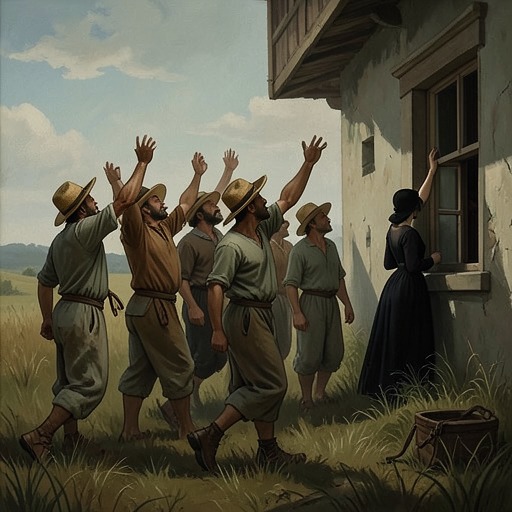
The House of Bernarda AlbaIn The House of Bernarda Alba, harvest season is the annual return of hired workers to the fields, but it also brings the outside world audibly and imaginatively to the women confined inside Bernarda Alba’s house. Poncia describes the arrival of forty or fifty young harvesters, recounts their hiring of a dancing woman, and identifies the season with open-air joy and movement. As their song draws near, Amelia and Magdalena give voice to the unequal freedom that defines the household: men go out to work and move through the village, while the women remain shut in. The season thus serves as more than a point in the agricultural calendar; it sharpens the play’s contrast between vitality beyond the walls and restriction within them.
Seasonal Labor and the World Outside
Poncia introduces the harvest as a recurring feature of local life. The workers arrived the previous morning, forty or fifty strong, from the mountains. The detail of their yearly arrival makes the season part of a familiar agricultural rhythm rather than an exceptional event. A note on the play also connects the influx of hired laborers to the working life Lorca knew on his father’s estate and neighboring landowners’ properties.
Her account makes the harvesters’ presence a social event as well as an economic one. She describes them as joyful, shouting and throwing stones, and says that the previous night a woman dressed in sequins came to the village dancing to an accordion. Fifteen of the men hired her and took her to an olive grove. Poncia says she watched from a distance and singles out the young man arranging the outing by his green eyes. The story places the workers’ public, mobile world close enough for the women to hear about, yet beyond the household’s walls.
Song at the Threshold
The harvest enters the scene not only through Poncia’s report but through sound. A distant song grows closer, and Poncia recognizes the singers as the workers. Amelia says they are going out to reap; the chorus’s harvest song accompanies their movement toward the fields. The song makes labor and outdoor life present onstage without bringing the workers into the room. The women listen from within, while the men’s activity remains outside their reach.
As the singing approaches, the contrast between the workers’ movement and the women’s confinement becomes explicit. Amelia says that being born a woman is the greatest punishment, and Magdalena adds that even their eyes do not belong to them. Their remarks arise alongside Poncia’s description of young men moving freely through the fields and village. The harvest scene therefore turns a seasonal sound into a point of comparison: the workers can leave for the fields, while the daughters experience their own bodies and even their looking as controlled.
Desire, Color, and Confinement
Poncia’s mention of the green-eyed young man links the harvesters’ world to the play’s established color imagery. The accompanying note observes that his green eyes connect him with flourishing nature and with Adela’s green dress and fan decorated with red and green flowers. The connection does not make him identical with any character or establish that he is one of the workers’ named figures; it marks a visual echo between the seasonal scene and the play’s imagery of vitality.
The scene’s effect depends on the distance it preserves. The women hear the approaching song and discuss the men, but they do not join them in the fields. Even the young man is seen, according to Poncia, from far away. Harvest season consequently gives the household a glimpse of movement, sociability, and life beyond its walls without breaking its enclosure. The workers’ annual return makes the surrounding world more present, while the women’s response reveals how sharply access to that world is divided by gender.